Coins bearing the image of Diadumenian
from Cibyra in Phrygia
This city, (also Kibyra) near the
sources of the Indus in southern Phrygia, was not incorporated into the Roman
province of
The provincial coins considered here coins bear no mark of value– nor do their sizes assist in any classification into denominations. Jones reports that an official rate of 16 assaria to a denarius is attested for Cibyra at around 100AD, some time before the Diadumenian examples were minted, though other evidence hints that this exchange rate may have been relatively stable for a considerable time, possibly until the late 3rd century. The sizes and weights of these coins ‘taken on their own’ do not give any other clue as to the mechanics of the monetary system of the day.
The Roman provincial coins of Cibyra in
Example 1
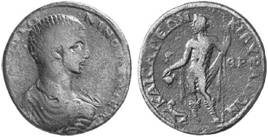
Ob.
M OΠEΛ ANTΩNINOC ΔIA K
Rev. KAICAPEΩN
KIBVPATΩN EΘP
Ref. Dr. Busso Peus Nachfolger
Auction 366 October 29th, 2000
24.35g,
Example 1 shows a reverse of Dionysus standing left holding
thyrsos and drapery with left hand and pouring kantharos with outstretched
right hand, panther at feet. The worship
of Dionysus was popular right across
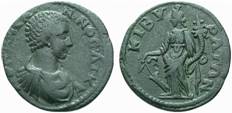
Example 2
Ob.
M OΠ ANT-ΩNINOC ΔIA K
Rev. KIBVPATΩN
Ref. SNG Aul. 3740;
8.04g 21mm,
The reverse of Example 2 shows Tyche standing left with rudder in right hand and holding cornucopia in left arm. The image is well engraved, though not outstandingly so. Indeed all of these coins are engraved to impress with their overall appearance but lack some of the subtle touches that would lift them into that premier league of artistry. Note the simple legend on the reverse simply stating that this is a coin from Cibyra. Again the obverse shows a similar image to that of Example 1. Here the details of the hair can be seen more clearly and it can be noticed that this seems to reflect the African origins of Diadumenian rather than the more European interpretations shown by other mints. Again the drapery is fully shown, a form favoured by this mint. Tyche is another of the popular deities shown on Roman provincial coinage, reflecting good fortune to the city as well as a secure and stable one.
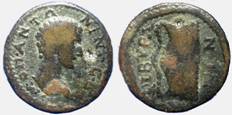
Example 3
Ob.
M OΠ ANTΩNINOC ΔIA K
Rev. KIBVPATΩN
Ref. Sear 3001 citing BMC
25.141.60; ISEGRIM 23132; SNG AUL 3741; BMC 17 S141,60; Hunter collection –
unpublished specimen (illustrated with permission)
4.0g 20mm,
Example 3 is a strange coin within the series. The weight is only half that of Example 2, though the diameters are almost the same. The obverse is the only coin to show no drapery having a simple bare headed bust – shown from behind. The reverse shows the wicker basket (or chest) symbol of the city. This design can be seen again in coins issued by Elagabalus.
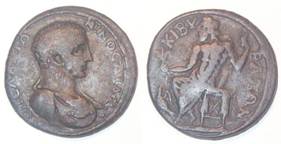
Example 4
Ob.
M OΠE ANTΩNINOC ΔIA K
Rev. KIBVPATΩN
Ref. SNG von Aulock 3739;
Lindgren & Kovacs 923 (this coin)
19.03g 32mm
Example 4 shows a very impressive portrait of Diadumenian, again well draped and showing tight curly hair. The image depicts the oldest representation of any of the designs of the series. The reverse depicts Zeus ‘Hypsibremetes’ seated left, holding thunderbolt and sceptre; eagle at his feet. Hypsibremetes translates to ‘the high thunderer’ a reference to his controlling of the weather. Again the reverse, while initially impressive, shows some weakness of design with Zeus not quite sitting on the chair, upper and lower body not being in proportion and the lower legs being poorly rendered.
Example 5
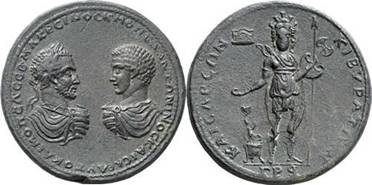
Ob.
AVTO KAI M OΠ CEB MAKPEINOC K M
OΠEΛ ANTΩNINOC KAICAR
Rev. KAICAPEON
KIBVPATΩN
Ref. Gorny & Mosch
Giessener Münzhandlung, Auction 146, March 6th, 2006, No.: 570 (illustrated
with permission); SNG Aul. 3738; Sear 2979.
61.32g, 44mm
The obverse of this coin shows a laureate bust of Macrinus wearing paludamentum right, and a bare headed bust of Diadumenian left wearing paludamentum, both busts being shown from behind and both sets of drapery being shown with heavy folds. The paludamentum is the cloak of a Roman general, worn similar to a chlamys and held by a broach at the shoulder. That particular garment is referenced here because of the heavy nature of the folds and the overall prominent nature of the design of it in the coins field. The reverse shows an Amazon standing facing, wearing an ornate headdress, holding spear and axe in left hand and holding patera over lit alter with right hand. There also appears to be a half moon shield in her left hand – though this is un-described in previous reports. An undetermined, but possible ‘crown’ object is present at the top left of the coins reverse. The Amazon, here, was regarded as the city goddess, so as these symbols and attributes all have religious significances the piece must be relaying the importance of religious devotions to the cities population. It is interesting that both the city goddess as represented by the Amazon and the more generic Tyche are both represented on this small coin series. Earlier examples from Caracalla show a simple city goddess seated on a throne and later examples of Serverus Alexander show Hectate as the city goddess, so the adoption of deities as the city’s protector must have been a fluid and adaptable practice among the locals
At 61g in weight and 44mm in diameter this coin was not meant for everyday use but must have been a presentational piece and with the existing examples being in usually excellent condition this seems to be borne out in evidence.
Malcolm Megaw
July 2007
References;
Private communication –
Coinarchives (www.coinarchives.com)
Ancient History Department of the University in Düsseldorf
Lindgren and F. L. Kovacs; Ancient Bronze Coins of Asia
Minor and the
J. R. Melville Jones, Testimonia Numaria. Greek and Latin Texts
concerning
Ancient Greek Coinage. Vol. I: Texts and translations (
Koenraad Verboven; Demise
and fall of the Augustan monetary system; Crisis and the Roman Empire (Proceedings of the 7th workshop of the
international network Impact of Empire,
2007, p. 245-257
Margaret C. Waites, The Deities of the Sacred Axe; American Journal of Archaeology, Vol. 27, No. 1 (Jan. - Mar., 1923), pp. 25-56